
The short answer
A school cannot avoid labor legislation merely by calling a full-time teacher an “independent contractor.” Nor can a company make statutory rights disappear by writing “this is a civil relationship” above the signature line. The decisive question is what the parties actually did.
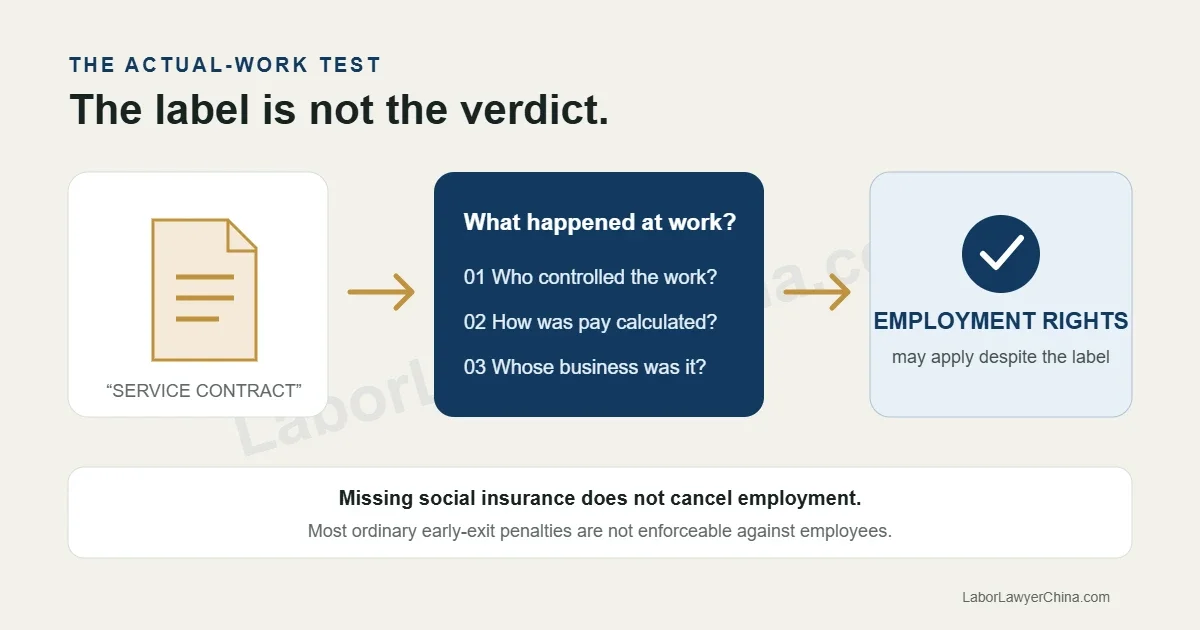
Substance over title
Management, economic dependence and integration into the business matter more than the document’s name.
Social insurance is separate
Non-payment is not a defense to employment status. It may instead create a contribution and compliance problem.
Exit penalties are restricted
An ordinary resignation fee will usually fail under an employment relationship. Statutory exceptions need proof.
Why the agreement says “service” or “civil”
Foreign teachers, consultants, designers and managers in China are often asked to sign a “service agreement,” “civil contract” or “cooperation agreement” instead of a standard employment contract. Sometimes the wording reflects a genuine independent engagement. Sometimes it simply moves the employer’s costs and risks onto the worker.
The practical difference is substantial. An employment relationship brings mandatory rules on wages, working time, rest, social insurance, termination and severance. A clause that conflicts with those rules may be invalid even when both parties signed it. Article 26 of the PRC Labor Contract Law specifically addresses terms that exempt an employer from legal responsibility, exclude employee rights or violate mandatory provisions.1
This does not mean every service provider is an employee. A freelancer who controls the work, serves several clients, sets the price and bears commercial risk may properly remain outside employment law. The label fails only when the facts point the other way.
| Test | Employment | Independent service | Evidence |
|---|---|---|---|
| Control | Set schedule and close supervision | Worker decides method and time | Rota, leave approval, messages |
| Pay | Regular wage for labor | Project fee with business risk | Payroll, invoices, bank records |
| Role | Part of the core operation | Separate outside service | Duty list, timetable, org chart |
| Tools | Employer supplies workplace and tools | Provider supplies own resources | Devices, classroom, email account |
The legal test: how courts look past the wording
Article 7 of the Labor Contract Law states that an employment relationship begins on the date the employer starts using the worker’s labor. Article 10 requires a written employment contract, but the absence of a document bearing that title does not erase an existing relationship.1
The 2005 Notice on Matters Relating to the Establishment of Employment Relationships remains the standard reference for undocumented or disputed arrangements. It identifies three connected features: eligible parties; paid work subject to the employer’s rules and management; and work forming part of the employer’s business. It also lists payroll records, work passes, recruitment records, attendance records and coworker testimony as relevant evidence.2
In court, this is not a box-ticking exercise based on one document. Judges examine the arrangement as a whole. Personal subordination concerns who directs the work. Economic subordination concerns whether the worker depends on regular remuneration rather than sharing profits and losses as an independent business.
A “cooperation agreement” functioned as an employment contract
(2018) Jing 01 Min Zhong No. 5911 · Beijing First Intermediate People’s Court
A manager signed a project-cooperation agreement with a culture company. He received a fixed monthly sum described as basic salary, reported on operations and attendance, followed instructions and needed approval for leave. He did not contribute capital or share business losses.
Holding: The court held that the agreement’s name was not decisive. Its terms and performance showed personal and economic subordination. The appellate court confirmed the employment relationship and upheld awards of unpaid wages and compensation for unlawful termination. It also treated the written agreement itself as sufficient to serve as a written employment contract, so it removed the separate double-wage award.5
The last point matters. Reclassification does not mean every claim automatically succeeds. A worker must still prove each remedy and deal with limitation periods. But the employer cannot win simply by producing a different heading.
Foreign workers: actual work plus lawful employment status
Foreign nationals face an additional issue: work authorization. Article 4 of the Supreme People’s Court Interpretation (II) on Labor Disputes, effective September 1, 2025, supports recognition of an employment relationship where the foreign worker has permanent residence, has obtained a work permit and is lawfully staying in China, or has completed the procedures required by national rules.3
That provision is important, but it is not a reason to ignore visa or permit problems. The employer named in the work permit, the actual workplace and the entity directing the work should be checked together. A third-party agency or a group company can complicate both status and liability.
Contracts, a work permit and management emails proved employment
(2019) Jing 01 Min Zhong No. 11117 · Beijing First Intermediate People’s Court
A foreign teacher signed teaching agreements with a Beijing school. The school obtained his work permit, provided housing and later sent an email ending the relationship. It then argued that he had never actually joined or worked for it.
Holding: The court relied on the contracts, work permit, emails and evidence of actual work. The school’s own management and termination messages supported the teacher’s case, while it could not explain its conduct. The court confirmed the employment relationship and upheld an award covering ordinary wages for the working period and sick-pay wages for the later period. The appeal was dismissed.6
A fixed timetable, required classroom attendance, school teaching materials, parent communications, leave approval and a monthly salary are usually more informative than a clause calling the teacher an “independent service provider.”
Build the evidence file before the dispute
Do not rely on the contract alone. Preserve the daily records that show how the job worked. Keep originals and export complete conversations rather than isolated screenshots. Back them up somewhere you will still be able to access after losing a company account.
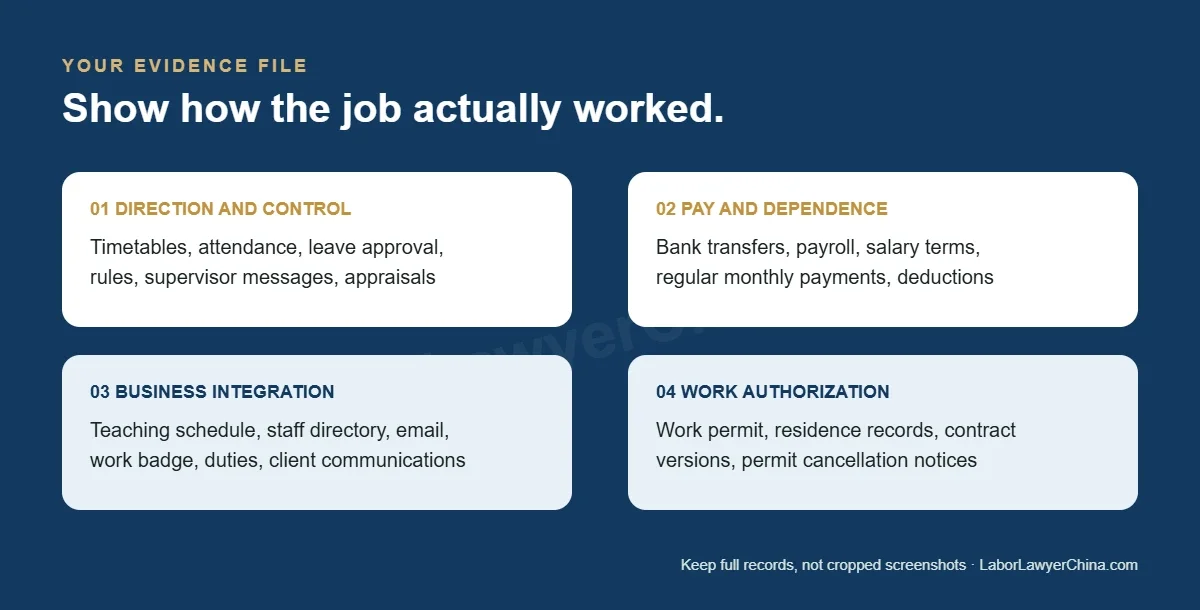
Keep context
A supervisor’s message is stronger with the full thread, date, account details and surrounding exchange.
Match the entity
Compare the contracting party, permit sponsor, payroll sender and daily manager. Record any differences.
Protect legality
Use records you lawfully possess. Do not take trade secrets or access accounts without authorization.
No social insurance does not mean no employment
Social insurance records are useful evidence, but they are not the legal switch that turns an employment relationship on or off. An employer’s failure to register or contribute cannot logically be used by that same employer to deny the relationship.
Articles 58 and 60 of the PRC Social Insurance Law require registration and full, timely contributions. Article 63 provides a process for the collection authority to order payment or make-up contributions. Article 97 applies the law to foreign nationals working in China. The revised Interim Measures for Social Insurance of Foreigners Employed in China also require covered foreign employees to participate in the five employee insurance schemes, subject to applicable treaty arrangements.47
Article 19 of the 2025 SPC interpretation adds that an agreement or employee waiver stating that no social insurance contributions are required is invalid. If the employer failed to contribute, the employee may rely on Article 38(3) of the Labor Contract Law to terminate and claim statutory severance, subject to the facts and procedural requirements.3
A claim to confirm employment is generally handled through labor arbitration and, if necessary, litigation. Registration and collection of unpaid social insurance are commonly pursued with the local social insurance administration or collection authority. A court judgment confirming employment can support that process, but a civil court will not necessarily calculate or order every back contribution in the same case. Local limits, contribution bases, treaty exemptions and the worker’s own statutory share need separate review.
Can the employer charge you for resigning early?
Under an ordinary employment relationship, usually not. Article 37 gives an employee the right to terminate on 30 days’ written notice, or three days’ notice during probation. This is a statutory right, not a request that the employer may refuse.
More importantly, Article 25 prohibits employee-paid contractual penalties except in the situations covered by Articles 22 and 23: a lawful service-period arrangement funded by special professional training, and a valid non-compete obligation. Calling the amount “compensation,” “recruitment cost” or “liquidated damages” does not change its substance.1
| Clause | Usual rule | Main limit | Check |
|---|---|---|---|
| Exit | Generally invalid as a penalty | Notice rules still apply | Written notice and delivery |
| Train | May be valid after special professional training | Capped by unamortized training expense | Actual invoices and training content |
| Non-c. | May be valid for restricted personnel | Scope and compensation must be lawful | Access to secrets and payments |
| Recruit | Ordinary hiring cost is the employer’s risk | Relabeling does not avoid Article 25 | Purpose and calculation |
Recruitment costs were really a prohibited resignation penalty
(2018) Yue 01 Min Zhong No. 10222 · Guangzhou Intermediate People’s Court
An employee’s contract required him to reimburse RMB 9,000 in recruitment costs if he resigned for personal reasons during probation. The employer argued that this was a service-fee reimbursement rather than a penalty.
Holding: The court looked at the trigger and payment obligation, not the label. The clause had the features of a contractual penalty and fell outside the statutory exceptions. It was invalid under Article 25. Recruitment expense was also part of the employer’s own management cost. The appeal was dismissed.8
Three qualifications deserve attention
First, a service-period penalty requires genuine expenditure on special professional training. Ordinary induction or routine supervision is not enough, and the amount is capped by the unperformed portion of the training expense.
Second, an invalid penalty is not the same as immunity from every proven loss. Article 90 addresses loss caused by unlawful termination or breach of confidentiality or non-compete obligations. Article 12 of the 2025 SPC interpretation separately allows a court to assess compensation where an employer provided special treatment beyond ordinary wages in return for a service period and the employee leaves early without an Article 38 ground. Actual loss, fault and years served all matter.3
Third, foreign-worker contracts need local review. In (2020) Hu 01 Min Zhong No. 2047, the Shanghai First Intermediate People’s Court rejected a kindergarten’s RMB 230,000 claim against a foreign teacher because she had complied with the governing Chinese-language contract. The judgment also discussed a more contractual approach to certain foreign-employee rights under the foreign employment rules. That local reasoning should not be confused with a general license to impose exit penalties, but it is a reason to assess the latest national law, local practice and the exact contract together.9
What to do if your employer denies the relationship
- Secure the full contract set. Keep the Chinese and English versions, amendments, offer letter, handbook and any side agreement. Do not assume the English text controls.
- Map the working reality. Write a short chronology covering hiring, work permit sponsorship, schedule, pay, supervision, leave and termination. Attach the supporting record for each event.
- Separate the claims. Confirmation of employment, unpaid wages, unlawful termination, social insurance and an alleged exit penalty may involve different legal tests and procedural routes.
- Check time limits early. Many labor claims are subject to a one-year arbitration limitation period, with special rules for remuneration during an ongoing relationship. Do not wait for informal negotiations to run out the clock.
- Get a local assessment before signing an exit document. A settlement, resignation letter or receipt can change the dispute. The employer’s business registration, work location and permit records should be reviewed before filing.
Frequently asked questions
Does a service contract prevent an employment relationship in China?
No. The title is evidence, not a legal bar. Courts also examine management, paid work, integration into the business and how the arrangement operated in practice.
Can a foreign teacher be recognized as an employee in China?
Yes, provided the legal requirements for foreign employment are met. Article 4 of the SPC’s 2025 labor interpretation addresses permanent residents, holders of work permits lawfully staying in China and persons who complete the required procedures.
Does no social insurance mean there is no employment relationship?
No. Missing contributions do not by themselves defeat an employment claim. Once the relationship and coverage obligation are established, the employer may be required through the applicable process to register and make up contributions.
Can my employer charge a penalty if I resign early?
Usually not under an ordinary employment relationship, except for lawful service-period and non-compete arrangements. Actual-loss claims and special-treatment arrangements require separate analysis.
Is an English-only agreement invalid?
Not simply because it is in English. Language, governing-version and local rules can affect interpretation. Preserve every signed version and obtain a reliable translation before relying on any clause.
Legal sources and court decisions
- PRC Labor Contract Law (2012 revision), Articles 7, 10, 22, 23, 25, 26, 37, 38 and 90. Current status verified November 9, 2026.
- Ministry of Labor and Social Security Notice on Matters Relating to the Establishment of Employment Relationships, Lao She Bu Fa [2005] No. 12, Items 1 and 2.
- Supreme People’s Court Interpretation (II) on the Application of Law in Labor Dispute Cases, Fa Shi [2025] No. 12, Articles 4, 12 and 19. Effective September 1, 2025.
- PRC Social Insurance Law (2018 revision), Articles 58, 60, 63 and 97.
- N. v. a Beijing culture company, (2018) Jing 01 Min Zhong No. 5911, Beijing First Intermediate People’s Court, September 26, 2018. Later issued as Beijing Court Reference Case No. 67.
- A Beijing school v. a foreign teacher, (2019) Jing 01 Min Zhong No. 11117, Beijing First Intermediate People’s Court, December 17, 2019.
- Interim Measures for Social Insurance of Foreigners Employed in China (2024 revision), Articles 3, 4, 8, 9 and 11.
- A Guangzhou restaurant-management company v. an employee, (2018) Yue 01 Min Zhong No. 10222, Guangzhou Intermediate People’s Court, July 13, 2018.
- A Shanghai kindergarten v. a foreign teacher, (2020) Hu 01 Min Zhong No. 2047, Shanghai First Intermediate People’s Court, May 7, 2020.
Case names and facts above have been abbreviated for readability. The case numbers, courts and holdings are retained for verification. These decisions illustrate reasoning; they are not guarantees of the same outcome in another case.
Republishing and sharing
You may reproduce this article without altering its legal meaning. Please credit LaborLawyerChina.com and retain a followed link to the canonical article:
https://laborlawyerchina.com/insights/service-contract-employment-relationship-china/
The figures may be downloaded and shared with their existing attribution. If your platform cannot display the images, upload the files to your own media library rather than hotlinking.
General information only. This article is not legal advice for a particular dispute. Employment status, foreign work authorization, social insurance and limitation periods require case-specific and local review.